
Utah's climate makes this question more urgent than in milder states. Cold winters and hot summers put attic insulation to the test twice a year, and getting the R-value wrong means paying for it every single billing cycle.
This guide breaks down recommended R-values by climate zone, how to check what you currently have, material comparisons, and when it's worth calling in a professional like Greenify Energy Savers.
Key Takeaways
- Utah homes typically need R-49 to R-60 in the attic, depending on county and elevation
- 9 out of 10 U.S. homes are under-insulated, according to ENERGY STAR
- Spray foam hits R-value targets faster, though its higher cost makes it less common for open attic floors
- Air sealing before insulating is essential; skipping it wastes money on the insulation upgrade
- An energy audit is the fastest way to know your exact starting point
Understanding R-Value: What It Means and Why It Matters
R-value measures how well insulation resists heat flow. The higher the number, the better the material blocks heat from moving through it — whether that's warm air escaping in January or hot attic air pressing down into your living space in July.
Here's something a lot of homeowners miss: R-value isn't fixed by material type alone. It depends on:
- Material type (fiberglass, cellulose, spray foam)
- Density — how tightly packed the fibers or cells are
- Thickness — more depth generally means more resistance
R-values are also cumulative. Layer R-19 batts under R-30 of blown-in insulation, and you get roughly R-49 combined, assuming both layers are installed correctly and neither is compressed.
Why Attics Need the Highest R-Value in the House
Not all parts of your home need the same insulation level. Walls, floors, and attics each have different recommended R-values, but attics almost always require the most.
Heat rises. In winter, warm indoor air pushes upward and escapes through an under-insulated ceiling plane. In summer, a sun-baked roof can turn your attic into an oven that radiates heat straight down into your living space.
Utah's Climate Zone 5 conditions push this even further — the U.S. Department of Energy recommends attic insulation between R-49 and R-60 for this zone, well above the R-13 to R-21 typically suggested for walls. That's why attic R-value recommendations sit well above wall or floor recommendations in every climate zone.
What R-Value Do You Need for Your Attic?
The Department of Energy and the International Energy Conservation Code (IECC) split the country into climate zones, each with its own recommended attic R-value. Here's the general breakdown:
| Climate Zone | Recommended Attic R-Value |
|---|---|
| Zones 1-3 (warm climates) | R-30 to R-38 |
| Zones 4-5 (mixed climates) | R-38 to R-49 |
| Zones 6-8 (cold climates) | R-49 to R-60 |
Most of Utah falls into Zone 5B or 6B, according to the 2021 IECC's county-level classification. Salt Lake City sits in Zone 5B, while higher-elevation areas like Summit County (Park City) fall into Zone 6B. Washington County, in Utah's southern tip, is the exception, landing in the milder Zone 3B.

So What's the Real Answer for Utah Homes?
For most homes across Utah's cold-climate zones, R-49 to R-60 is the target range the DOE recommends as cost-effective for existing homes. Higher elevations and areas with the most severe winter swings benefit most from pushing toward R-60.
The exact number depends on which standard you're referencing:
- 2021 IECC model code: sets R-60 as the ceiling minimum for Zones 4-8
- Utah's 2024 amended state guide: lists R-49 for Zones 5 and 6
- DOE retrofit recommendation: R-49 to R-60 for existing homes
If you're unsure which applies to your project, a local energy auditor can clarify.
How Much Insulation Material Do You Actually Need?
Here's where things get practical. R-value per inch varies dramatically by material, so hitting R-49 or R-60 requires very different depths depending on what you install.
R-value per inch by material:
- Fiberglass batts: roughly R-3.27 to R-3.5 per inch
- Blown-in fiberglass: about R-2.9 per inch
- Blown-in cellulose: about R-3.7 per inch
- Open-cell spray foam: about R-3.5 per inch
- Closed-cell spray foam: about R-6.5 per inch
How Thick Is R-60 Attic Insulation?
Using those figures, here's roughly what R-60 looks like in real depth:
- Blown-in fiberglass: approximately 20.5 inches
- Blown-in cellulose: approximately 16-17 inches (initial depth, before settling)
- Closed-cell spray foam: approximately 9.2 inches
That's a significant difference. Spray foam hits R-60 in less than half the depth of blown fiberglass, though it comes at a higher material cost and is more commonly used in wall or rim-joist applications than open attic floors.

Why Even Coverage Matters More Than the Number on the Bag
A bag might promise R-60, but compressed or unevenly distributed insulation won't deliver it. Thin spots near the eaves, insulation flattened by foot traffic, or gaps around vents and chimneys all reduce your attic's effective R-value, even if the average depth looks right on paper.
Professional installers use blower calibration and depth markers throughout the attic to ensure consistent coverage, not just a good number at the access hatch. Greenify Energy Savers' insulation crews check depth at multiple points across a Utah attic, including eaves and corners, so the R-value you're paying for is the R-value you actually get.
How to Check Your Current Attic Insulation
Before you buy anything, find out what you're starting with. Here's the DIY method:
- Grab a flashlight and a ruler, and safely access your attic.
- Measure depth at several spots — not just one. Coverage is often uneven.
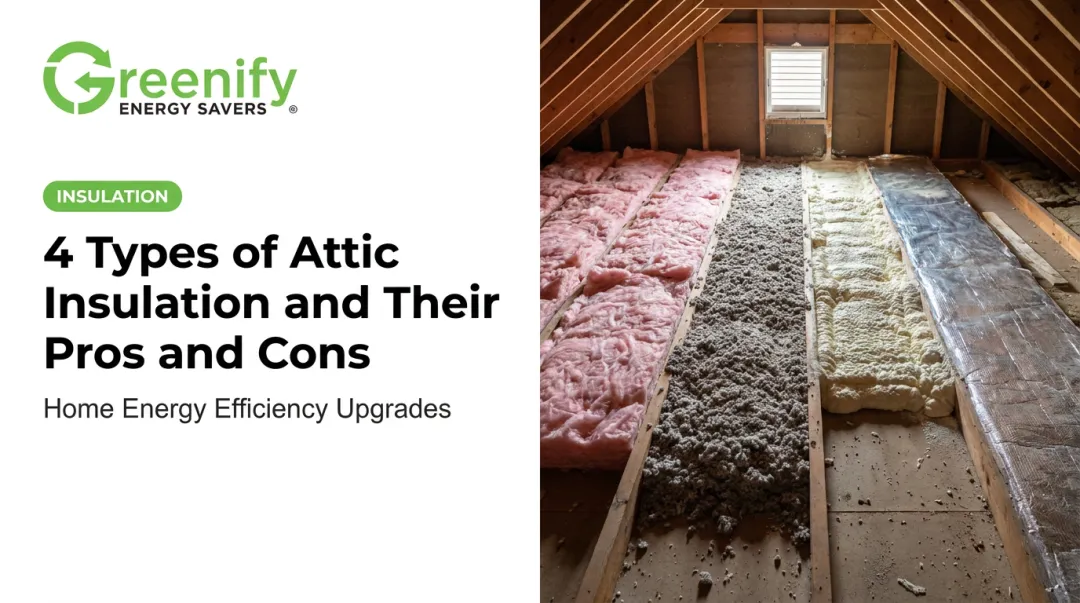
- Identify the material by appearance:
- Pink or yellow batts = fiberglass
- Gray, shredded paper-like material = cellulose
- White pellets or loose fill = loose-fill fiberglass
- Solid, foam-like coating = spray foam
- Calculate your approximate current R-value: depth (inches) × R-value per inch for that material.
- Compare your total against the R-49 to R-60 benchmark for your zone.

If your insulation sits at or below the top of the floor joists, that's a strong sign you're under-insulated. Most joists are 8 to 10 inches deep — nowhere close to what a cold-climate attic needs.
That joist-level shortfall is more common than most homeowners realize. ENERGY STAR estimates that 9 out of 10 U.S. homes are under-insulated, including many built before modern energy codes existed. If your house was built decades ago and hasn't been updated since, there's a good chance it falls into that group.
If your numbers come up short, a professional home energy audit can confirm exactly where you stand and what upgrades make the most sense before you invest in new material.
Signs Your Attic Is Under-Insulated
You don't always need a ruler to know something's wrong. Watch for these symptoms:
- Uneven room temperatures: upstairs rooms that are freezing in winter and stifling in summer
- HVAC systems running constantly, struggling to maintain a consistent temperature
- Ice dams and icicles forming along the roofline in winter, a classic sign of heat escaping through the attic and melting snow unevenly
- Rising utility bills without a clear explanation like a rate increase
That ice dam issue deserves extra attention in Utah. When warm air leaks through an under-insulated or poorly air-sealed ceiling, it warms the roof deck, melts the snow sitting on top, and that meltwater refreezes at the colder eaves.
The result: ice buildup that can damage shingles, gutters, and even cause water intrusion.
According to an ENERGY STAR fact sheet on air sealing, air leakage alone accounts for 25% to 40% of a home's heating and cooling energy use. That's why sealing gaps in the attic floor matters just as much as insulation depth: insulation without air sealing is like wearing a warm coat that's unzipped.

Greenify Energy Savers checks for both issues during a home energy audit, since fixing one without the other rarely solves the comfort problem.
Is Upgrading to R-60 Worth It? Costs, Savings, and Getting It Right
For Utah's cold-climate zones, R-60 is generally worth the upgrade, even though it costs more upfront than stopping at R-49. The extra material pays for itself through consistently lower heating bills across long Utah winters, particularly in higher-elevation areas where temperature swings are more extreme.
The EPA estimates that homeowners save an average of 15% on heating and cooling costs from combined air sealing and insulation upgrades — about 11% on total energy costs. That figure reflects sealing and insulating together, not attic insulation alone — the two steps work better as a pair than either does solo.
Payback periods vary widely depending on your starting point. A home going from bare joists to R-60 will see a faster return than a home already sitting near R-49. Several factors shape the final cost:
- Attic square footage and roofline complexity
- Material choice (blown-in fiberglass vs. cellulose vs. spray foam)
- Access difficulty, including existing ductwork or storage in the attic
Figuring out which factors apply to your attic is exactly what Greenify Energy Savers evaluates on every job. Founded in 2012 by brothers Aaron and Wyck, the Utah-based company has spent over a decade helping homeowners tackle this kind of upgrade. Greenify's standard recommendation for Utah attics is a full R-60 using blown-in fiberglass, installed at roughly 22 inches of depth — reflecting just how demanding local winters can be on an under-insulated home.
That depth only delivers its full R-value if air leaks are addressed first. Greenify pairs attic upgrades with air sealing, since closing gaps before adding insulation ensures the new material actually performs as intended. They also offer combined insulation-and-radiant-barrier bundles for homeowners tackling both winter heat loss and summer heat gain in one project.
If you're not sure whether your attic needs R-49 or R-60, or you just want an accurate read on what's currently up there, a free energy evaluation is the simplest way to get real numbers instead of guesswork.
Frequently Asked Questions
What is a good R-factor for attic insulation?
It depends on your climate zone. Colder regions like Utah generally need R-49 to R-60, while warmer states can get by with R-30 to R-38. Elevation and local temperature swings push the number higher.
How thick is R-60 attic insulation?
Roughly 16-20 inches for blown-in fiberglass or cellulose, and about 9 inches for closed-cell spray foam. The exact depth depends on the specific product and its rated R-value per inch.
Is R-60 attic insulation worth it?
In cold climates, yes. The extra upfront cost compared to R-49 typically pays off through lower heating bills over several winters, especially in homes starting from little to no existing insulation.
How do I know if my attic has enough insulation?
Measure the depth against your floor joists — insulation at or below joist height usually means you're under-insulated. Uneven room temperatures, ice dams, and high energy bills are other red flags.
Can I add new insulation over old insulation in my attic?
Generally, yes, as long as the existing insulation is dry, free of mold, and not compressed or contaminated. Wet or deteriorated insulation should be addressed before adding new material on top.
How much does upgrading attic insulation typically cost?
Costs vary based on attic size, current insulation levels, and material choice. An energy audit from Greenify Energy Savers gets you an accurate number specific to your attic.