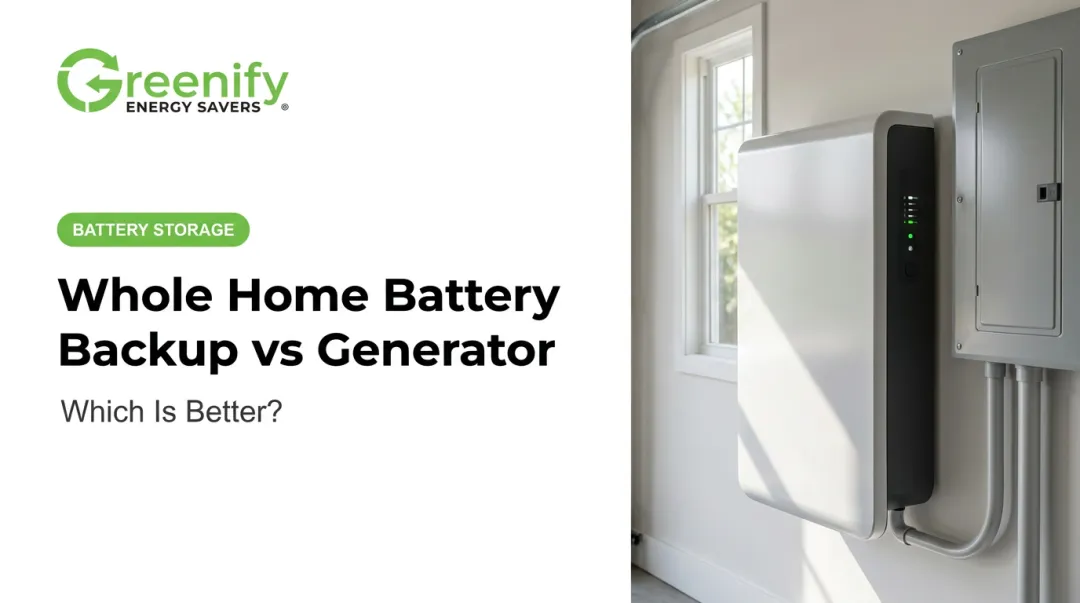

Portable generators and gas cans used to be the fallback. Now homeowners want something quieter, cleaner, and automatic. A whole-home battery system charges from solar or the grid, then kicks in the instant power drops, no extension cords required.
The shift is already happening. Wood Mackenzie found that the share of US residential solar installations paired with storage jumped from 6% in Q1 2020 to 25% in Q1 2024, according to Wood Mackenzie's state-of-storage report. This guide breaks down the top systems for 2026 and how to size one correctly for your house.
TL;DR
- Whole-home battery systems store solar or grid energy to keep critical circuits or the whole house running during outages
- Sizing hinges on kWh capacity, kW output, chemistry, and how well the system scales
- Battery-only costs typically run $986–$1,293 per kWh, per NREL benchmark data, before installation labor
- Top picks: Tesla Powerwall 3, Enphase IQ Battery 10T, FranklinWH aPower 2, Generac PWRcell 2, and Anker Solix X1
- A professional home energy assessment prevents both overpaying and underbuying capacity
Overview of Whole-Home Battery Backup Systems
A whole-home battery backup system is a permanently installed, wired-in unit that can power your entire electrical panel, not just a few outlets.
That's the key difference from portable power stations, which handle small appliances for a few hours, or partial-circuit backup, which powers only pre-selected circuits, such as a fridge and a few lights.
Whole-home systems connect directly to your panel or a dedicated backup subpanel. They charge from solar panels, the grid, or in some cases a generator, then discharge automatically when utility power fails.
Adoption is accelerating fast. US residential battery storage installations topped 800 MW in 2025, up 75% from 2024. Outside California and Hawaii, LBNL data shows attachment rates climbing from roughly 1% in 2017 to 6% in 2024.

With that context set, here's how the leading whole-home systems stack up against each other for 2026.
Top Whole-Home Battery Backup Systems for 2026
We evaluated each system on energy capacity, continuous power output, battery chemistry and safety certification, scalability, warranty terms, and true whole-home backup capability, not just partial-circuit coverage. Greenify Energy Savers installs several of these systems for Utah homeowners, matching battery capacity and backup type to each home's energy needs and local rebate eligibility.
Tesla Powerwall 3
Tesla remains the best-known name in home battery storage, and the Powerwall 3 consolidates the inverter, battery, and monitoring hardware into one all-in-one unit. Multiple Powerwalls can stack together for larger homes needing more coverage.
It stands out for its high continuous output and Tesla's app, which shows real-time solar production, battery charge, and home consumption from a phone.
| Spec | Rating |
|---|---|
| Capacity | 13.5 kWh (AC nominal) |
| Continuous Output | Up to 11.5 kW |
| Warranty | 10 years |
Enphase IQ Battery 10T
Enphase built its reputation on microinverter technology before expanding into storage, and the IQ Battery 10T carries that modular philosophy forward. It's passively cooled, meaning no fans, no noise.
The 10T's biggest advantage is scalability. Installers can add units incrementally as a household's needs grow, backed by one of the longest warranties in the category.
| Spec | Rating |
|---|---|
| Capacity | 10.08 kWh usable |
| Continuous Output | 3.84 kW |
| Warranty | 15 years or 6,000 cycles |
FranklinWH aPower 2
FranklinWH designed the aPower 2 to work whether or not solar is present. It can charge from the grid, a generator, solar panels, or even vehicle-to-load (V2L) sources.
Smart circuit-level load management sets it apart. The system prioritizes essential circuits automatically during an outage, stretching stored energy further without homeowner intervention.
| Spec | Rating |
|---|---|
| Capacity | 15 kWh usable |
| Continuous Output | 10 kW |
| Warranty | 15 years or 60 MWh throughput |
Generac PWRcell 2
Generac spent decades building whole-home generators before entering battery storage, and that legacy shows in the PWRcell 2's dealer support network. Homeowners who already trust Generac for backup power have a natural upgrade path.
Its modular cabinet design lets you scale from a single unit up to two cabinets for larger loads, with strong installer availability nationwide.
| Spec | Rating |
|---|---|
| Capacity | 9-18 kWh per cabinet (up to 36 kWh with two) |
| Continuous Output | 5.2-10.5 kW per cabinet; 11.5 kW max with two cabinets |
| Warranty | 10 years |
Anker Solix X1
Anker is a newer entrant to permanent home storage, but the Solix X1's weather-resistant design makes it one of the few systems rated for true outdoor installation.
An IP65 rating and wide operating temperature range mean it tolerates garages, sheds, or exterior walls without a climate-controlled enclosure. Modules stack from one to six per power unit, so capacity grows with the household.
| Spec | Rating |
|---|---|
| Capacity | 4.6 kWh usable per module (1-6 modules) |
| Continuous Output | 6.0 kW on-grid; 6.6 kW off-grid |
| Warranty | 10 years |

How to Choose the Right Whole-Home Battery Backup System
How Much Does a Whole-Home Battery Backup Cost?
NREL's 2023 benchmark modeling of a paired 8 kW solar and 12.5 kWh battery system puts the added cost of storage at roughly $986 to $1,293 per kWh. For a single 10-15 kWh unit, that translates to $10,000 to $19,000 in equipment and installation, before any incentives.
Here's the incentive landscape for 2026:
- The federal 30% Residential Clean Energy Credit is no longer available for expenditures after December 31, 2025, per current IRS guidance
- Utah homeowners can still tap Rocky Mountain Power's Wattsmart Battery Program, which now offers a flat $2,000 rebate per household as of May 1, 2025 (down from up to $5,000-$6,000 previously)
- Greenify Energy Savers, a certified Rocky Mountain Power Trade Ally, helps homeowners apply for this rebate and works alongside Maxwell Power (Previously HDM Renewable Finance), a national leader in renewable finance, to offer the local community unprecedented flexibility and value - including savings of 25% on battery and/or solar systems
How Large of a Battery Backup Do You Need?
Once you've budgeted for storage, sizing is the next decision. It comes down to matching capacity against your essential loads (refrigerator, well pump, medical equipment) versus your entire home's draw, including HVAC.
Lawrence Berkeley National Laboratory modeled this trade-off directly:
- A 10 kWh solar-plus-storage system met basic household needs during a three-day outage when heating and cooling were excluded
- That same 10 kWh system covered only 86% of critical load once HVAC was factored in
- Bumping capacity to 30 kWh raised coverage to 96% with HVAC included, according to LBNL's household backup power study
Winter heating is the wild card. In counties with heavy electric-heat reliance, coverage swung from 53% to 96% depending on when an outage started. Utah's cold winters make this especially relevant.
A professional home energy assessment, like the ones Greenify Energy Savers conducts across Utah, calculates actual interval load data and HVAC draw rather than relying on rough estimates. That's the difference between a system that covers your furnace in January and one that runs out by dinner.
Key Features to Compare Before Buying
Beyond capacity and output, a few technical details separate strong systems from mediocre ones:
- Battery chemistry: Lithium iron phosphate (LFP) offers better cycle life and thermal stability than older lithium-ion options. The Department of Energy notes even LFP can release hydrogen gas during thermal runaway, so it isn't a complete safety guarantee on its own
- Scalability: Modular systems like Enphase, Generac, and Anker let you add capacity later without replacing the whole unit
- App-based monitoring: Real-time visibility into charge state, solar production, and outage status
- Solar-charging compatibility: Confirm whether the battery works with your existing inverter or requires a specific pairing
Every system reviewed here carries UL 9540 certification at the system level, the current standard published in 2023 for stationary energy storage equipment. Chemistry matters, but certification is what actually verifies fire safety.

How We Chose the Best Systems
Buyers make two mistakes more than any other: underestimating their essential load requirements, and skipping past warranty fine print to focus on sticker price alone.
Our evaluation weighed:
- Safety certification (UL 9540 and UL 1973 compliance at the system level, not just the battery cell)
- Capacity and output ratings as published directly by manufacturers, not third-party estimates
- Manufacturer track record, including how long each company has serviced installed systems
- Warranty terms, since a 15-year warranty with a cycle cap can behave very differently from a 10-year warranty with unlimited cycles
Retained-capacity conditions varied widely across our five picks, from 60% to 70% of original capacity at the warranty's end. That single detail can matter more than an extra kWh of rated capacity, particularly for homeowners planning to keep a system for a full decade or longer.
Conclusion
The right whole-home battery backup comes down to matching capacity, output, and warranty terms to your household's essential loads and budget, not chasing the biggest brand name.
A 10 kWh unit might cover a smaller home skipping HVAC backup, while a larger household running a furnace through Utah winters likely needs 20 kWh or more, possibly across two stacked units.
Before you sign a contract:
- Compare scalability options across systems
- Read the warranty's fine print on cycle limits and retained capacity
- Calculate total installed cost against available rebates like Rocky Mountain Power's Wattsmart Battery Program
If you're in Utah and want a clear answer on what your home actually needs, Greenify Energy Savers offers personalized energy assessments that combine battery backup sizing with solar and efficiency upgrades. Call 801-948-4464 to get started.
Frequently Asked Questions
How much does a whole house battery backup system cost?
Battery equipment typically runs $986 to $1,293 per kWh based on NREL benchmark modeling, meaning a 10-15 kWh system costs roughly $10,000 to $19,000 installed. Utah homeowners can offset this with Rocky Mountain Power's Wattsmart Battery Program rebate.
What is the best battery backup system for a home?
It depends on your capacity needs, budget, and whether you have solar. Tesla Powerwall 3 suits high-output needs, Enphase 10T fits modular solar setups, and FranklinWH works well with or without solar already installed.
How long can a battery backup power a house?
Runtime varies based on capacity and load. LBNL research found a 10 kWh system covers 86% of critical loads including HVAC during a three-day outage, while 30 kWh systems reached 96% coverage.
How large of a battery backup do I need for my house?
Start by listing essential loads (refrigeration, medical equipment, heating) versus your full home's draw. A professional home energy audit measures actual usage data to right-size capacity rather than guessing.
Do I need solar panels to use a home battery backup?
No. Batteries can charge from the grid, a generator, or solar. Pairing with solar maximizes savings and keeps the battery recharging during extended outages when grid power isn't an option.
How long do home battery backup systems typically last?
Manufacturer warranties run 10 to 15 years, with retained capacity guarantees between 60% and 70% of original rating. Actual lifespan varies by cycle count, chemistry, and how the system is maintained.